
Introduction to the Ethics of AI 2026
Lecture, University of Osnabrück, Summer Term 2026, Prof. Dr. Rainer Mühlhoff
Navigation: This is the current version of this lecture in the summer term 2026.
Archive of past versions: [Summer Term 2025], [Summer Term 2024], [Winter Term 2022/23], [Winter Term 2021/22].
Recordings

General information
Access / Video link
The lecture can be accessed in three formats:
- On site: Thursdays 14:15–15:45 CEST, starting 09 April 2026, room: see Stud.IP (for university members only).
- Live stream in Big Blue Button: Thursdays 14:15–15:45 CEST [BBB-Link]
- Asynchronous participation via video recordings published on this website. I will make the recordings available by Friday afternoon each week.
The lecture is public. Everybody can participate, although some additional functionality such as access to PDFs (slides, weekly discussion group readings) through Stud.IP, as well as participation in the weekly discussion groups, are exclusive to registered students.
Contact for students: For questions concerning the lecture, please write to eoailecture2026 (ät) ethikderki.de.
Course description
This philosophical lecture provides an introduction to the emerging field of the Ethics and Critical Theories of AI. It is open to all interested students of all levels, including those from the humanities, as well as scientific and technical disciplines.
The lecture is an ideal starting point to get an orientation in the field and to possibly start engaging with more specialized courses and/or research projects in the context of the Ethics and Critical Theories of AI group at the Institute for Cognitive Science.
The lecture will provide an overview of relevant problems, philosophical theories and critical methods. This includes both the philosophical foundations of ethics, critical theory and some aspects of social philosophy (such as power and social structures) as well as different technological phenomena and legal aspects of AI. A particular focus will be contemporary data-driven and machine learning-based AI technology and its applications in digital consumer media. As we will see, questions of social equality and fairness are central to today’s ethical concerns about AI, so that ethics needs to adopt a societal perspective, analyzing constellations of power, subjectivation, discrimination and subordination that relate to AI technology. Ethics will be framed in relation to intersectional critical philosophy, feminist and post-colonial theories. We will also touch upon relevant legal debates such as privacy and data protection legislation and AI regulation.
Programme
The programme is a living document – please visit this site regularly for updates.
| Session | Date | Lecture Topic | Background Readings (Discussion Groups) |
|---|---|---|---|
| 1 | 09.04. | Introduction / Human-Aided AI; Orga | Videos: 1) “Human Computation”, Google Tech Talk by Luis von Ahn, 2006. YouTube 2) “Artificial Intelligence is the New Electricity”, Stanford Talk by Andrew Ng, 2017. YouTube Coeckelbergh, Mark. 2020. AI Ethics. Cambridge, MA: The MIT Press. Chapters 1–2. |
| 2 | 16.04. | Ethics 101 | Dignum, Responsible AI, Chapter 3. |
| 3 | 23.04. | Bias & Discrimination | Videos: Joy Buolamwini Video 1, Video 2, Kimberle Crenshaw Video Background reading: Friedman, Batya, and Helen Nissenbaum. 1996. “Bias in computer systems.” ACM Transactions on Information Systems 14(3). |
| 4 | 30.04. | Power 101 | Sattarov, Faridun. 2019. Power and Technology: A Philosophical and Ethical Analysis. Lanham: Rowman & Littlefield, pp. 17–26. Optional: Mühlhoff, Rainer. 2025. The Ethics of AI: Power, Critique, Responsibility. Bristol University Press. From the Introduction pp. 1–3; from Chapter 4, pp. 75–84. Optional background reading: Manifesto for a Power-Aware Ethics of AI, pp. 172–181. |
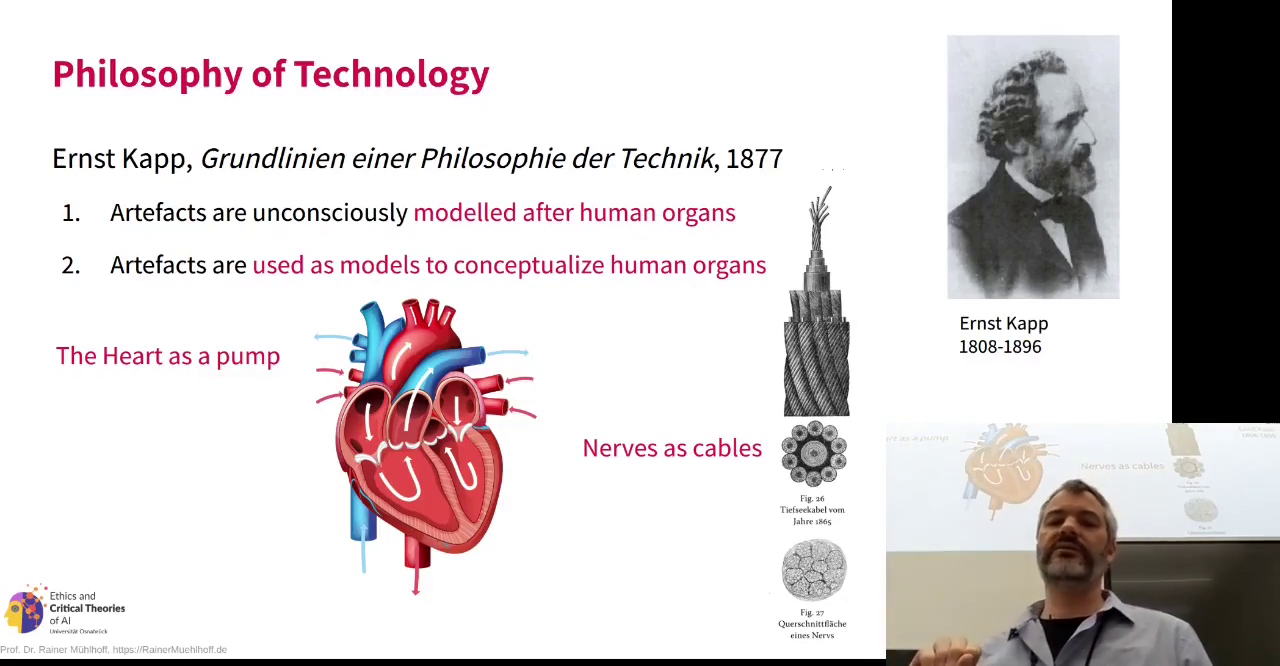
| 5 | 07.05. | Philosophy of Technology 101 | Winner, L. 1980. “Do Artifacts Have Politics?” Daedalus 109: 121–136. |
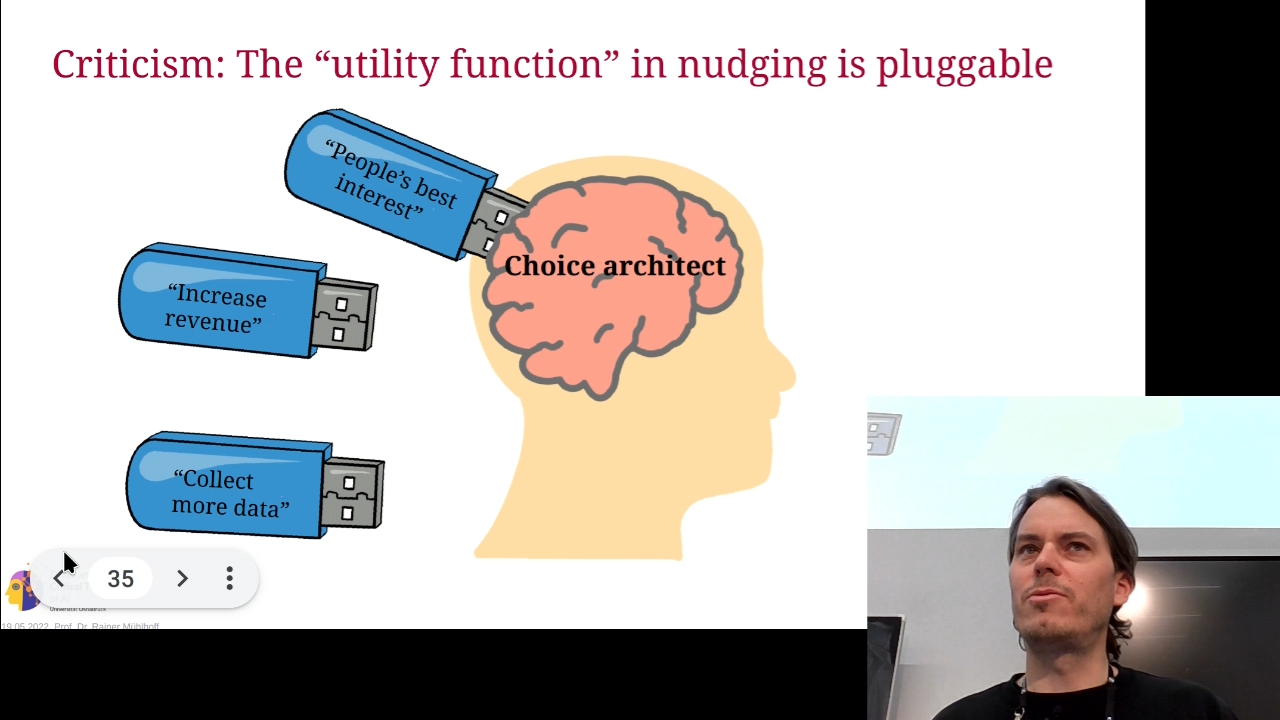
| 6 | (14.05.) | No on-site lecture (bank holiday). Optional self-study: “AI Paternalism: Nudging & Design Tricks” [watch here] |
Discussion groups will take place! Mildner et al. 2023. “Defending Against the Dark Arts: Recognising Dark Patterns in Social Media.” arXiv. https://arxiv.org/abs/2305.13154. Optional background reading: Mühlhoff, Rainer. 2025. The Ethics of AI: Power, Critique, Responsibility. Bristol University Press. Chapter 3. |
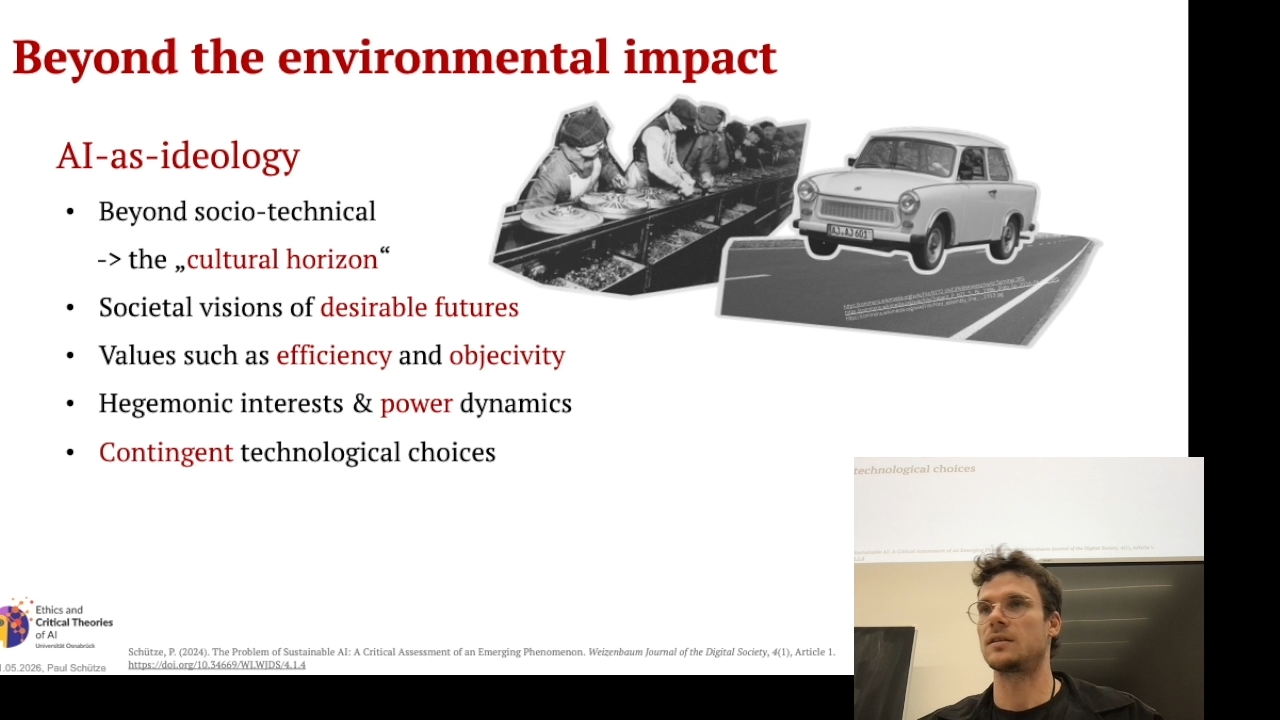
| 7 | 21.05. | AI and Sustainability | van Wynsberghe, A. (2021). Sustainable AI: AI for sustainability and the sustainability of AI. AI and Ethics, 1(3), 213–218. DOI: 10.1007/s43681-021-00043-6. Optional background reading: Heilinger, J.-C., Kempt, H., & Nagel, S. (2024). Beware of sustainable AI! Uses and abuses of a worthy goal. AI and Ethics, 4(2), 201–212. DOI: 10.1007/s43681-023-00259-8. |
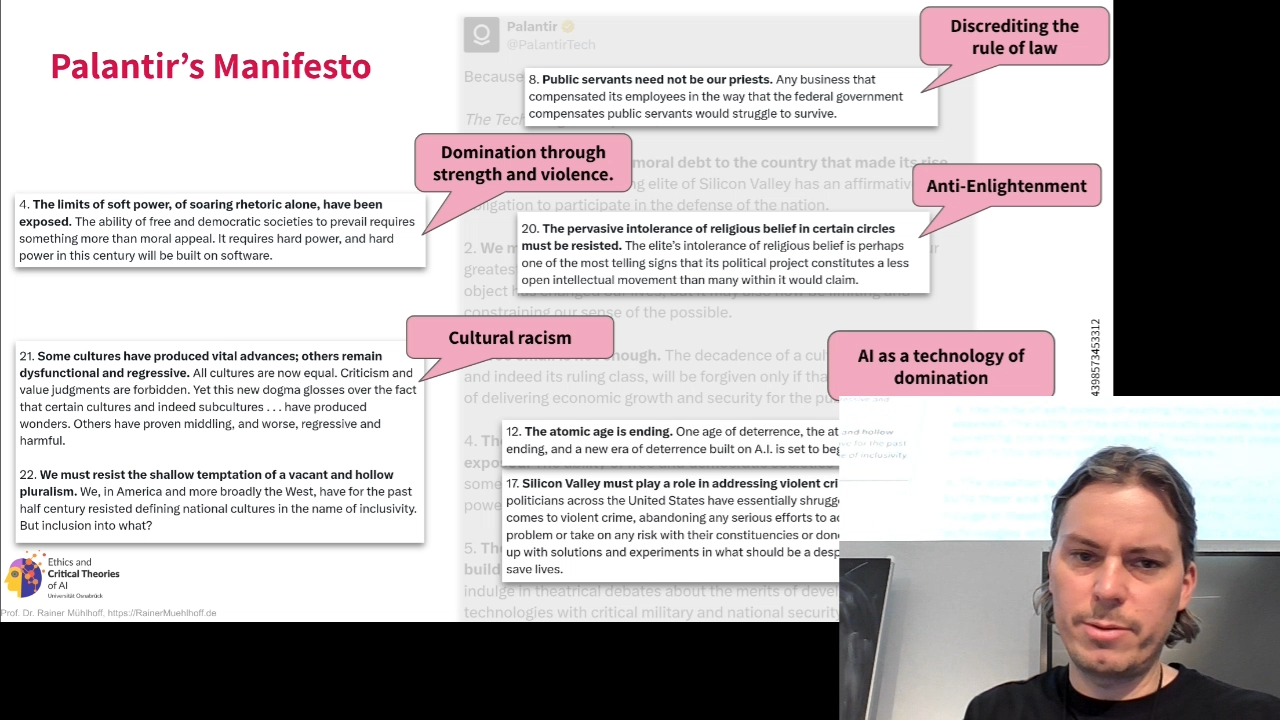
| 8 | 28.05 | Tech Ideologies | Gebru, Timnit, and Émile P. Torres. 2024. The TESCREAL Bundle: Eugenics and the Promise of Utopia through Artificial General Intelligence. First Monday, April. DOI: 10.5210/fm.v29i4.13636. Optional background reading: Golumbia, David. 2024. Cyberlibertarianism: The Right-Wing Politics of Digital Technology. Minneapolis: University of Minnesota Press. Optional background reading: Mühlhoff, Rainer. 2025. Künstliche Intelligenz und der neue Faschismus. Stuttgart: Reclam. |
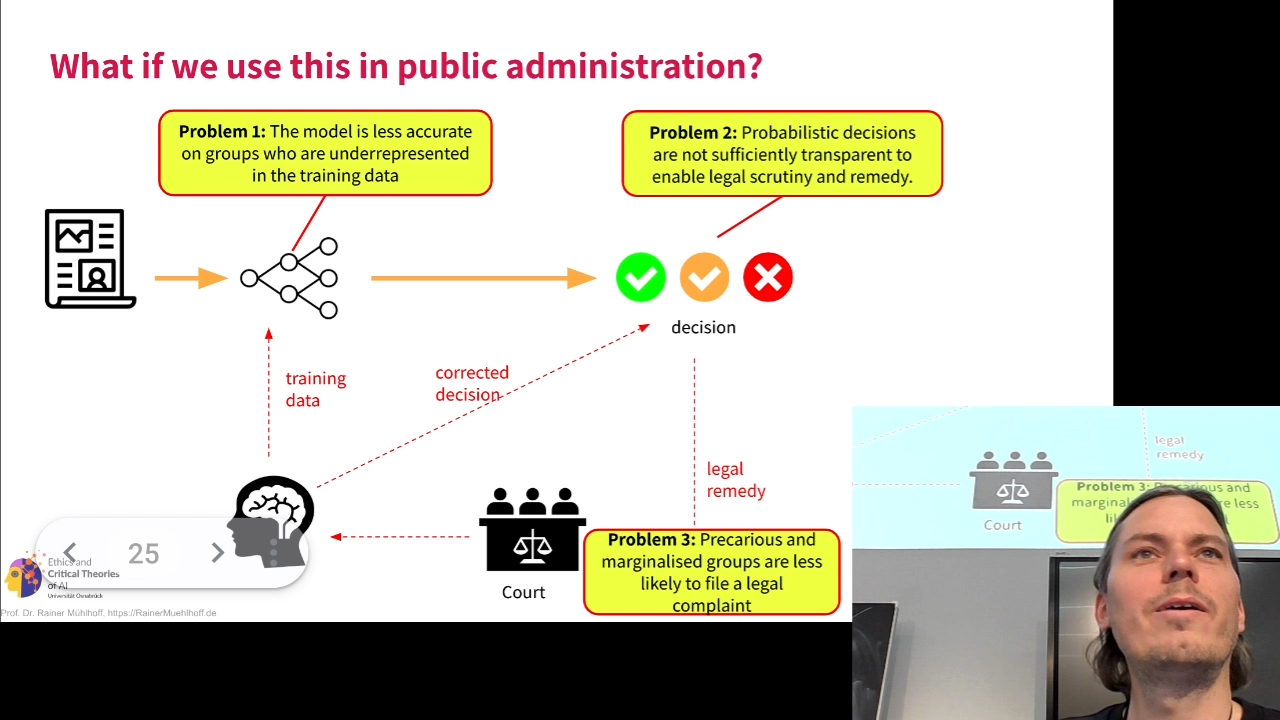
| 9 | 04.06. | AI and the State | Bria, Francesca. 2025. The Authoritarian Stack. How Tech Billionaires Are Building a Post-Democratic America — And Why Europe Is Next. https://authoritarian-stack.info/ |
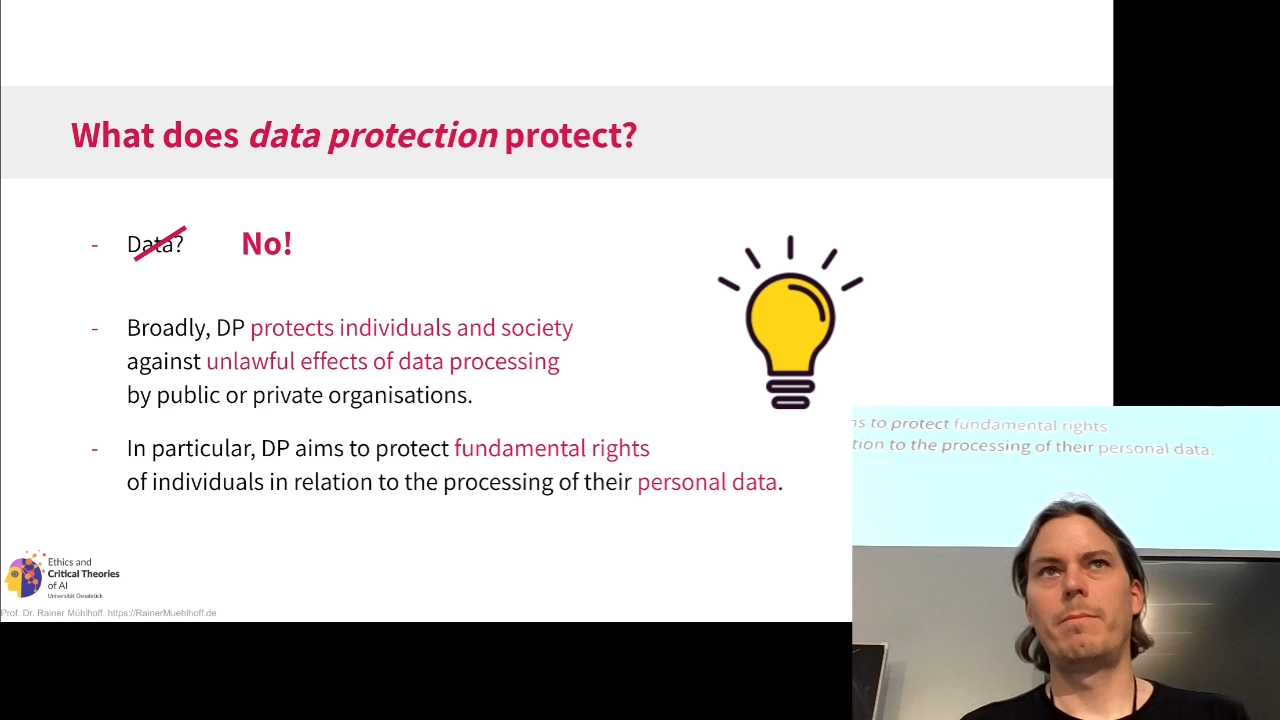
| 10 | 11.06. | Basic Principles of Constitutionalism and Data Protection | Roberts, Brandon, and Vernal Coleman. 2025. Inside the AI Prompts DOGE Used to Munch Contracts Related to Veterans Health. ProPublica, June 6, 2025. https://www.propublica.org/article/inside-ai-tool-doge-veterans-affairs-contracts-sahil-lavingia. |
| 11 | 18.06. | Data Protection & EU Digital Legislation | Wachter, Sandra. 2018. The GDPR and the Internet of Things: A Three-Step Transparency Model. Law, Innovation and Technology 10 (2): 266–94. Read only pages 1–10 (until the end of section 3.1). DOI: 10.1080/17579961.2018.1527479. Wachter, Sandra. 2019. Data Protection in the Age of Big Data. Nature Electronics 2 (1): 6–7. DOI: 10.1038/s41928-018-0193-y. |
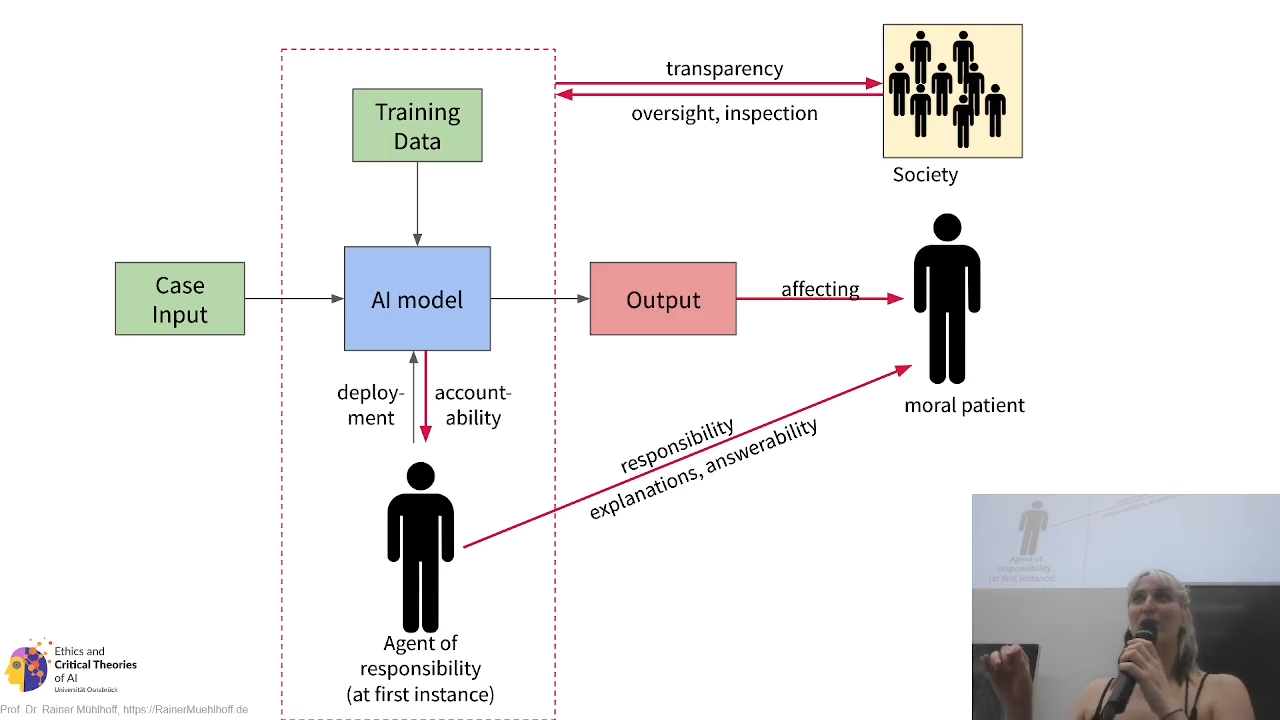
| 12 | 25.06 | Responsibility & Explainability | Coeckelbergh, Mark. „Artificial intelligence, responsibility attribution, and a relational justification of explainability“. Science and Engineering Ethics 26(4), 2020: 2051–68. DOI: 10.1007/s11948-019-00146-8 |
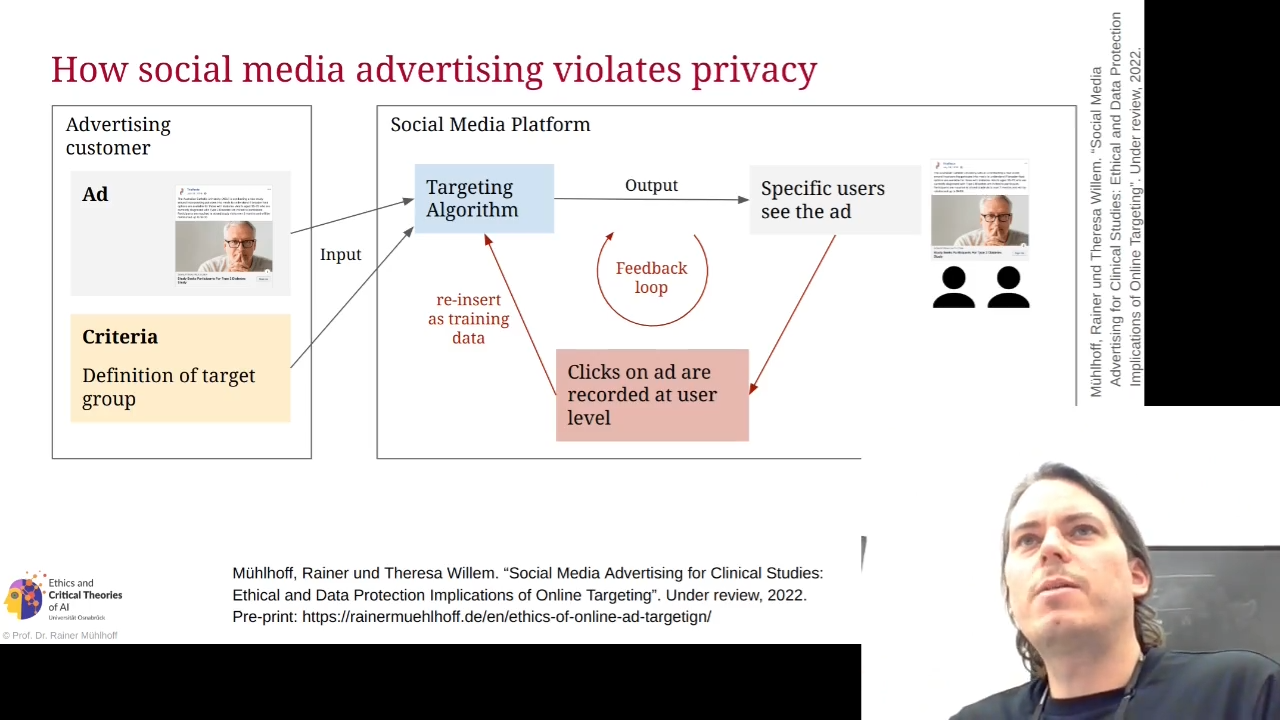
| 13 | 02.07. | Data Protection and AI | Mühlhoff, Rainer. 2021. Predictive Privacy: Towards an Applied Ethics of Data Analytics. Ethics and Information Technology 23: 675 90. DOI: 10.1007/s10676-021-09606-x. |
| 14 | 09.07. | Written exam / Klausur | more information |
Grading stuff
ECTS points for registered students
The class is offered as a lecture with optional discussion groups. Registered students can earn 4 ECTS points for the lecture and additional 4 ECTS points for discussion groups.
- Lecture: regular participation in the lecture is required (on site, streaming or recordings). Final written exam on Thu. 9 July 2026, 14–16, in the lecture hall (in-person only, no remote exam). For those who fail the exam, there will be a make-up exam date in the first week of the winter term.
- Closed book exam on paper on site in the lecture hall; mostly multiple choice questions; no electronic devices allowed.
- Important: Register for the exam in EXA/HISinOne! Registration ends 1 week before exam. Not registered = no exam. You can register now and unregister until one week before the exam.
ECTS points / certificate for external students and exchange students
If you are an external student participating from anywhere in the world, or if you are an exchange student at the University of Osnabrück but cannot register for the exam through EXA/HISinOne, you can still obtain 4 ECTS points under the following circumstances:
- Make sure to participate in the exam on site in Osnabrück.
- Provide a pre-filled document/certificate you want me to sign (PDF).
- Send this to my office before the exam date: office-muehlhoff (ät) uni-osnabrueck.de. Subject line: exam ethics of AI.
Discussion Groups (optional)
Discussion groups are optional and with limited capacity. They offer in-depth discussion of the lecture content and beyond. Perfect if you would like to get deeper into the field. Discussion groups meet 2 hrs/week with 15–20 students per group. Participants have to prepare a weekly reading.
For completing a discussion group you can earn additional 4 ECTS points for the “freie Wahlbereich”. To earn points, you have to participate regularly in your discussion group and hand in a video or audio podcast as a graded homework once during the semester. Please find details, advice & FAQ on video/audio homework here.
Important: To receive points you will have to register for the exam in EXA/HISinOne by week 3 of term!!
Capacities for discussion groups are limited to 5x 20 students. Registration on Stud.IP starts Friday 10 April, 12:00 pm CEST. First come, first served. All discussion groups are on-site and in English.
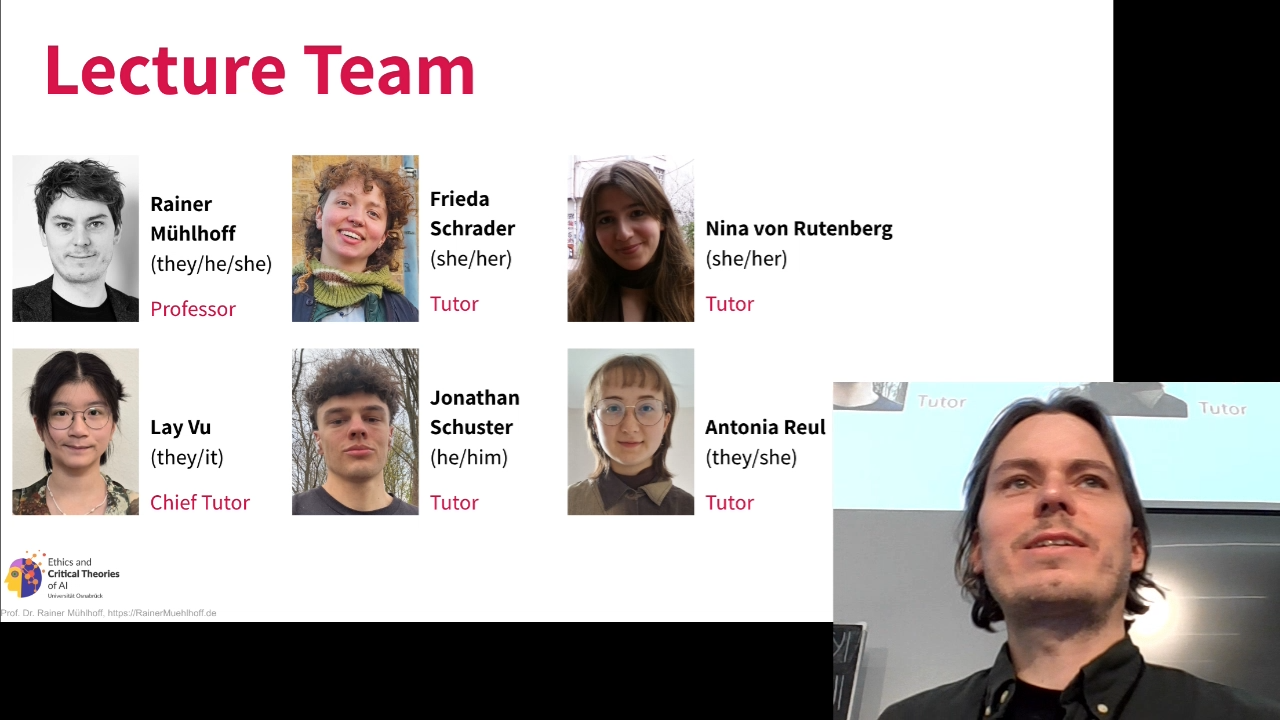
List of available discussion groups:
| Group | Time | Room | Tutor | Free capacity |
|---|---|---|---|---|
| 1 | Mon. 10–12 | 15/230 | Frieda Schrader | 20 |
| 2 | Mon. 14–16 | 35/E22 | Nina von Rutenberg | 20 |
| 3 | Tue. 12–14 | 35/E22 | Lay Vu | 20 |
| 4 | Wed. 12–14 | 35/E22 | Antonia Reul | 20 |
| 5 | Wed. 14–16 | 35/E22 | Jonathan Schuster | 20 |
Information about the written exam on 9 July 2026
Please help us run a smooth exam with 300 participants across four different locations by observing the following instructions.
Registration
- Please register for the exam on EXA/HISinOne until 1 week before the date. After that date, registrations will close. If you cannot register for technical reasons, please come to the exam anyway. But make sure you tried registering.
- You can also cancel your registration until one week before the exam in the EXA/HISinOne system.
- If you are entitled to a Nachteilsausgleich, please send an email with the relevant documentation to my office at office-muehlhoff (ät) uni-osnabrueck.de no later than one week before the exam, and we will find an individual solution.
- If you are sick on the day of the exam, please write an email to my secretary Andrea Katz at office-muehlhoff (ät) uni-osnabrueck.de with the subject line “Intro to the Ethics of AI: exam”, briefly detailing your situation and attaching proofs (e.g., doctor’s note).
- If you are registered for the exam but do not show up without a valid excuse, we will have to enter a grade 5.0 into the EXA/HISinOne system. You can then participate in the retake exam.
When and where does the exam take place?
- The exam will take place in rooms 01/EZ04, 01/B01 and 01/B02. Please follow this distribution according to the first letters of your last name:
- Last names A-F ==> Room 01/EZ04
- Last names G-L ==> Room 01/B02
- Last names M-Z ==> Room 01/B01
- Please arrive on time at 14:00 (no c.t.) on the exam day (9 July). Wait until you are admitted to the room and then take a seat promptly. We aim to start at 14:15.
- When taking a seat, fill the rows starting in the middle of each row. Only every second row will be open, and only every second seat may be occupied.
Rules and procedure during the exam
- You need to bring a photo ID (student ID or official document with photo) and place it on your table. It will be checked during the exam.
- The exam is strictly closed-book: No notes, books, digital tools (tablets, computers, smartphones, smartwatches) are allowed. Breaching this rule will lead to immediate exclusion (Täuschungsversuch).
- The exam takes 90 minutes.
- After you have finished your exam, please stay seated and do not leave the room so as not to disturb others. There will be one opportunity to leave the room after 60 minutes; otherwise, please stay until the end of the exam. Do not use electronic devices during that time.
- Please leave your seat only once your exam sheet has been collected by the supervisors. That is, please stay seated until the supervisor has passed through your row to collect the exam sheets.
Format and content of the exam
- The exam is multiple choice. It covers questions on the lecture sessions. In broad terms, each session will be covered.
- The exam will focus on important definitional, conceptual and factual questions. Sometimes you will be asked to make a judgment.
- The exam is approximately 12 pages long, in font size 11.
- The best preparation is to go through the slides again.
Retake exam
- The retake exam will most likely take place in the first week of the winter termin (erste Vorlesungswoche); the exact date has not yet been determined.
- If you fail, are sick or do not show up in the first exam, you can participate in the retake exam as a second chance.
- Please register for the retake exam until one week ahead in EXA/HISinOne.