New open-access article: What does “delegation” mean in LLM use—and how can we distinguish its ethical degrees?
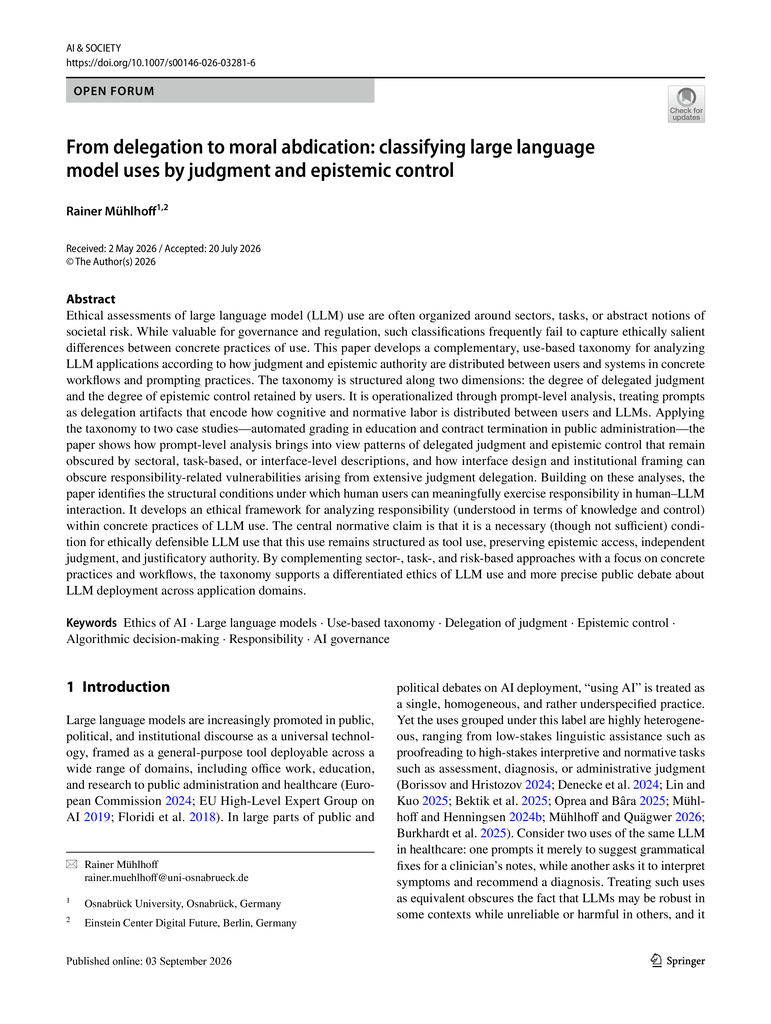
My new article “From delegation to moral abdication: classifying large language model uses by judgment and epistemic control” has been published in AI & Society and is available open access.
The article develops a use-based taxonomy for large language model applications. Instead of classifying applications solely by sector, task, or abstract risk category, the framework focuses on concrete prompting practices and workflows along two dimensions: How much judgment is delegated to an LLM? And how much epistemic control do users retain over the knowledge base the LLM draws on when processing the prompt? Taken together, these dimensions help distinguish forms of cognitive offloading that may look similar at the interface level but differ significantly in their ethical implications. It analyzes prompts as “delegation artifacts” that make visible how cognitive and normative labor is distributed between users and systems.
Through two case studies—automated grading in education and contract termination in public administration—the article shows how interfaces and institutional framing can obscure extensive judgment delegation and the resulting responsibility-related vulnerabilities.
Its central normative claim is that ethically defensible LLM use must remain structured as tool use. Human users need to retain epistemic control over the underlying knowledge base, independent judgment, and the ability to justify and take responsibility for decisions. Where these conditions are absent, delegation threatens to become moral abdication.
Download options and bibliographic data
-
 Mühlhoff, Rainer. 2026. „From delegation to moral abdication: classifying large language model uses by judgment and epistemic control“. AI & Society. doi:10.1007/s00146-026-03281-6.
Full text Publisher's website bibtex
×@article{Mü2026MoralAbdication, title = {From delegation to moral abdication: classifying large language model uses by judgment and epistemic control}, author = {Mühlhoff, Rainer}, date = {2026}, journaltitle = {AI \& Society}, issn = {0951-5666, 1435-5655}, doi = {10.1007/s00146-026-03281-6}, url = {https://link.springer.com/article/10.1007/s00146-026-03281-6}, urldate = {2026-09-03}, keywords = {Ethics of AI, Large language models, Use-based taxonomy, Delegation of judgment, Epistemic control, Algorithmic decision-making, Responsibility, AI governance}, langid = {english}, web_group = {aktuell}, web_thumbnail = {/assets/images/publications/Mü2026MoralAbdication.jpg}, web_fulltext = {https://link.springer.com/content/pdf/10.1007/s00146-026-03281-6.pdf}, web_publisher = {https://link.springer.com/article/10.1007/s00146-026-03281-6} }